


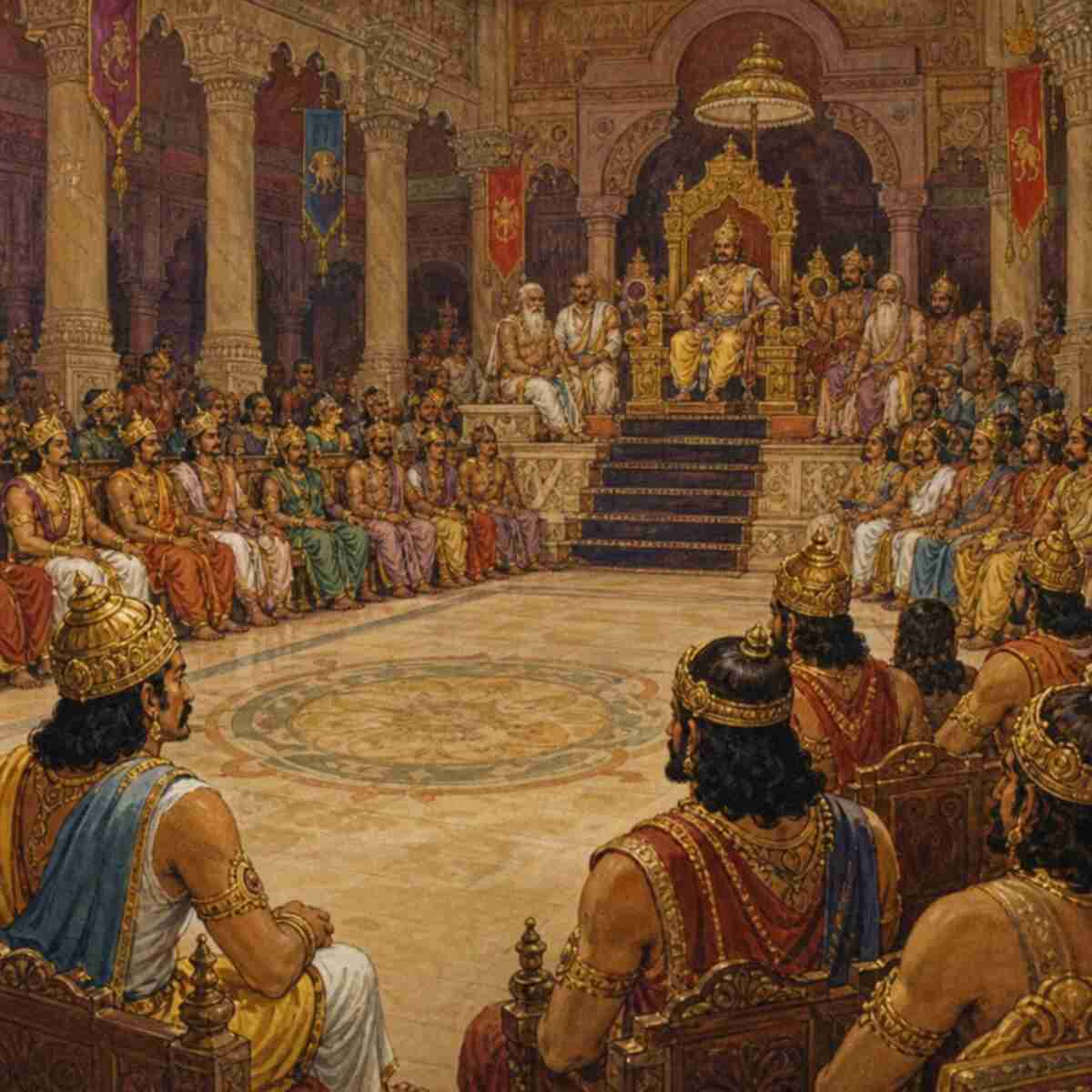
The story of the Mahabharata is an ocean of complex characters, political intrigue, and profound philosophical dilemmas. Yet, if one were to pinpoint the exact moment the great Kurukshetra War became inevitable, it would not be a clash of swords on a battlefield. It would be the haunting clatter of dice echoing through the opulent assembly hall of Hastinapur. The actual Interesting Info about Gsc108.
The mahabharat game of dice is arguably the most critical turning point in ancient Indian literature. It is a masterclass in psychological manipulation, a stark study of human frailty, and a chilling demonstration of how unchecked ambition can burn an empire to the ground.
In this comprehensive exploration, we will delve into the strategic dimensions, historical context, and moral complexities of this fateful event. From the mechanics of ancient board games to the intricate legal arguments presented by Draupadi, we will unpack why this single event remains immensely relevant to modern strategists, leaders, and thinkers.
Table of Contents
1. The Historical and Cultural Context of Gambling in Ancient India
To truly understand the gravity of the game of dice in mahabharat, we must first look at how gambling was viewed in ancient Indian society. It was not merely a modern casino-style pastime; it was deeply intertwined with statecraft, honor, and theology.
Understanding the Terminology
Let us begin with the Sanskrit definition of Dyuta Krida. The term Dyuta derives from the Sanskrit root div, which encompasses meanings ranging from “to play” and “to gamble” to “to shine” and “to throw.” Krida translates to play, sport, or amusement. In the context of ancient India, Dyuta Krida was recognized as one of the traditional pastimes of the Kshatriya (warrior and ruling) class. It was a test of nerve, strategy, and one’s standing with fortune.
The Moral Implications of Gambling in Puranas
Despite its popularity among royals, ancient texts were acutely aware of its dangers. The Moral implications of gambling in Puranas and earlier Vedic texts are overwhelmingly cautionary. The Rig Veda features the famous “Gambler’s Lament” (Aksha Sukta), a poignant poem detailing a man who loses his wealth, his wife, and his societal standing to the dice, warning readers: “Do not play with dice, but cultivate thy tillage.”
In Puranic literature, gambling is frequently associated with the dark age of Kali Yuga. In fact, when King Parikshit (the grandson of Arjuna) allowed the demon Kali to reside in his kingdom, one of the five places he assigned to him was the gambling house—a place where deceit, greed, and loss of dharma inherently thrive. The Mahabharata’s dyuta sabha (gambling assembly) serves as the ultimate narrative manifestation of this ancient warning.
2. The Mechanics of the Game: Chaupar and the Illusions of Chance
When we picture the game of dice, it is essential to visualize what the characters were actually playing. They were not rolling six-sided dice for simple numbers; they were playing a complex, highly strategic board game known as Chaupar (or a very close ancient equivalent, such as Pasha).
Ancient Indian Chaupar Game Rules
To appreciate the strategy involved, we must examine the rules of the Ancient Indian game of chaupar.
- The Board: The game is typically played on a cross-shaped board made of cloth or drawn on the floor, consisting of four arms.
- The Pieces: Each player controls a set of pawns (often made of wood or ivory).
- The Objective: The goal is to navigate one’s pawns around the outer perimeter of the board and bring them safely to the center (the “home” or Chauka).
- The Movement: Movement is dictated by the throwing of cowrie shells or, as in the Mahabharata, long, rectangular dice known as Pasha.
Players could form strategic blockades, capture opponents’ pieces by landing on their squares, and use complex tactics to control the board’s pacing. It required mathematical calculation and deep strategic foresight.
Chaupar Compared to Modern Board Games
If we analyze Chaupar compared to modern board games, its closest descendants are Ludo or Parcheesi. However, unlike Ludo, which relies heavily on the blind luck of a single six-sided die, ancient Chaupar was a game of “open information” combined with probability. Expert players could calculate the odds of certain throws and position their pieces defensively to minimize risk. It was a game that mirrored the battlefield—requiring both tactical positioning and the favor of fortune.
The Symbolism of the Ivory Dice
In the epic, the dice themselves carry profound metaphorical weight. The Symbolism of the ivory dice extends far beyond simple gaming tools. They represent the inexorable ticking of time (Kala) and the unpredictability of fate (Daiva). Every clatter of the ivory on the board symbolized the crumbling of the Kuru dynasty’s foundation. The dice were the ultimate equalizer—reducing kings to beggars in a matter of moments.
The Dark Secret: Shakuni Magic Dice Origin
But this was no fair game of chance. The Hastinapur match was rigged from its inception due to the Shakuni magic dice origin.
According to regional variations and popular folklore surrounding the epic, Shakuni, the prince of Gandhara, held a deep-seated vendetta against Hastinapur (specifically Bhishma) for the destruction of his family. It is said that while imprisoned, Shakuni’s father, King Subala, instructed Shakuni to use his bones after his death to craft a pair of dice.
These dice were infused with Shakuni’s potent grief, dark magic, and unyielding desire for revenge. The dice would obey Shakuni’s verbal commands. When Shakuni rolled, he was not playing the odds; he was dictating reality. This magical subversion of the game’s mechanics transformed a friendly wager into a weapon of mass destruction.
3. The Mastermind and the Motivations
To understand the strategic depth of the mahabharat game of dice, we must analyze the psychological profiles of the two primary players: Shakuni and Yudhisthira.
The Influence of Shakuni on the Kauravas
Shakuni was a master psychologist. He recognized early on that Duryodhana, the eldest Kaurava, could never defeat the Pandavas in open, honorable combat. The Pandavas had the might of Bhima, the unmatched archery of Arjuna, and the divine backing of Lord Krishna.
The Influence of Shakuni on the Kauravas was absolute. He preyed upon Duryodhana’s deep-seated insecurities, which had been severely aggravated after witnessing the unparalleled wealth and grandeur of the Pandavas’ newly built capital, Indraprastha (the Maya Sabha). Shakuni proposed a bloodless coup. He told Duryodhana: “What you cannot win through the strength of your arms, I will win for you through the sleight of my hands.”
Shakuni engineered the situation perfectly. He convinced King Dhritarashtra to invite the Pandavas to Hastinapur for a “friendly” game, knowing that Yudhisthira’s adherence to protocol would force him to accept.
Why Yudhisthira Wagered His Kingdom
One of the most frequently asked questions by readers of the epic is: Why Yudhisthira wagered his kingdom, his brothers, and his wife? Yudhisthira was known as Dharmaraja, the embodiment of righteousness. How could such a wise king make such catastrophic decisions?
The answer lies in a complex mix of duty, fatalism, and psychological entrapment:
- The Kshatriya Code: According to the ruling class’s code of conduct, a king could not refuse a direct challenge to battle or a game of dice. To refuse was considered an act of cowardice and a breach of Dharma.
- Proxy Play: Shakuni manipulated the rules of engagement. He announced that he would roll the dice on Duryodhana’s behalf, who would provide the stakes. Yudhisthira objected, noting this was highly irregular, but ultimately yielded to peer pressure and the taunts of the assembly.
- Fatalism: Yudhisthira was acutely aware of impending doom. The epic notes that when destruction approaches, a man’s reasoning is clouded (Vinasha Kale Viparita Buddhi). Yudhisthira felt the heavy hand of fate guiding him, blinding his usually impeccable judgment.
- The Psychology of the Gambler: As the game progressed, Yudhisthira fell into the classic psychological trap of “chasing losses.” With every defeat, his desperation to win back his honor and wealth clouded his rational mind.
4. The Unfolding Tragedy: A Step-by-Step Breakdown
The Sequence of stakes in the gambling match is a masterful study in strategic escalation. Shakuni did not ask for the kingdom right away. He started small, drawing Yudhisthira deeper into the web.
Here is the heartbreaking sequence of how an empire was lost on a board:
- Phase 1: Material Wealth Yudhisthira began by wagering pearls, gold, and vast treasuries. Shakuni, using his enchanted dice, won effortlessly. “I have won,” Shakuni would declare with a chillingly calm demeanor.
- Phase 2: Military Assets Stung by the loss, Yudhisthira wagered chariots, magnificent steeds, and war elephants. The pride of the Indraprastha army was stripped away in minutes. Again, Shakuni won.
- Phase 3: Human Capital The stakes grew darker. Yudhisthira wagered thousands of male and female servants, artisans, and citizens of his kingdom. He was treating human lives as commodified chips. The dice rolled; Shakuni won.
- Phase 4: The Kingdom of Indraprastha In a moment of blind desperation, Yudhisthira pushed his entire empire into the center of the metaphorical table. He wagered the very land he and his brothers had toiled to turn from a barren desert into a utopia. Shakuni’s dice clattered, and Indraprastha was gone.
- Phase 5: His Brothers Having lost all material possessions, Yudhisthira wagered his youngest brothers, Nakula and Sahadeva. After losing them, he wagered the mighty Bhima and the peerless Arjuna. Shakuni expertly praised the brothers before taking them, using psychological warfare to ensure Yudhisthira kept playing.
- Phase 6: Himself Left with nothing else, Yudhisthira wagered his own freedom. He lost, becoming a slave to the Kauravas.
At this point, the game should have ended. But Shakuni, knowing the ultimate prize was the Pandavas’ complete humiliation, leaned in and whispered the most venomous suggestion of the epic. He reminded Yudhisthira that he had one more piece of “wealth” left: his queen.
- Phase 7: The Final Wager Yudhisthira, entirely broken and devoid of reason, wagered Draupadi. A collective gasp echoed through the hall. The dice rolled for the final time. Shakuni smiled. He had won.
5. The Climax of the Assembly: Ethics and Legality on Trial
The moment Draupadi was wagered and lost, the narrative of the Mahabharata shifted from a political dispute to a profound moral crisis. The subsequent events in the assembly hall remain some of the most debated and analyzed passages in global literature.
The Ethics of the Dyuta Sabha
The Ethics of the dyuta sabha completely collapsed the moment human beings were treated as chattel. The Hastinapur assembly was filled with the most learned, powerful, and respected men of the age: Bhishma (the grand patriarch), Dronacharya (the royal preceptor), Kripacharya, and Vidura.
Yet, when Duryodhana ordered his brother Dushasana to drag Draupadi into the court by her hair, the silence of these elders was deafening. Their inaction highlighted a terrifying truth: when strict adherence to the letter of the law supersedes the spirit of morality, society rots from within. The elders were paralyzed by their oaths of loyalty to the throne, confusing bureaucratic duty with moral courage.
Draupadi’s Legal Questions to Kuru Elders
Draupadi did not weep silently. Despite her menstruation and wearing only a single garment, she stood before the assembly radiating absolute fury and intellect. She bypassed emotional pleas and instead launched a devastating legal and philosophical inquiry.
The Draupadi’s legal questions to Kuru elders centered around one brilliant paradox:
- “Did Yudhisthira lose himself first, or did he lose me first?”
If Yudhisthira lost himself first (which he did), he became a slave to Duryodhana. Under ancient law, a slave owns no property and has no rights. Therefore, as a slave, Yudhisthira had no legal authority to wager Draupadi. Furthermore, she argued that a wife is not the personal property of a husband to be gambled away, challenging the deepest patriarchal norms of the era.
Bhishma, the wisest man in the room, lowered his head and offered a weak, legally evasive answer: “Dharma is subtle, my child. I cannot answer your question definitively.” This moment marks the intellectual and moral death of the Kuru elders long before arrows pierced them on the battlefield.
Draupadi Vastraharan Incident Analysis
What followed was the darkest chapter of the epic. Duryodhana ordered Dushasana to strip Draupadi of her garments in front of the entire court to finalize her humiliation as a slave.
A thorough Draupadi vastraharan incident analysis reveals that this was not just an act of physical violence; it was an attempt to strip the Pandavas of their Kshatriya honor permanently. By attacking their queen in public, Duryodhana sought to mentally break the Pandavas so completely that they would never dare challenge him for the throne again.
The Role of Lord Krishna in the Assembly Hall
When human laws, familial ties, and the protection of husbands failed her, Draupadi surrendered her ego entirely. She raised her hands to the heavens and called out to her ultimate friend and protector.
The Role of Lord Krishna in the assembly hall is pivotal, even though he was not physically present in Hastinapur at the time. Through divine intervention, Krishna answered her plea. As Dushasana pulled at Draupadi’s sari, the cloth miraculously extended. Yard after yard, silk of vibrant colors flowed from her, creating a mountain of fabric in the center of the hall. Dushasana eventually collapsed from exhaustion, but Draupadi remained clothed, her honor protected by divine grace.
This miracle is profoundly symbolic. It signifies that when earthly justice fails and human institutions collapse under the weight of corruption, absolute surrender to the divine (Dharma) is the only salvation.
The Impact of Dhritarashtra’s Inaction During the Game
Throughout this horrifying ordeal, the blind King Dhritarashtra sat quietly. The Impact of Dhritarashtra’s inaction during the game cannot be overstated. His blindness was not merely physical; it was a deep, willful moral blindness fueled by an obsessive love for his toxic son, Duryodhana.
Only when horrifying omens appeared—jackals howling in the sacrificial fires and donkeys braying in the royal stables—did Dhritarashtra panic. Fearing a curse from the virtuous Draupadi that would destroy his lineage, the King finally intervened. He offered Draupadi boons, through which she secured the freedom of her husbands and the return of their weapons.
Dhritarashtra’s leadership failure is a timeless lesson: passive complicity in the face of injustice is just as destructive as the injustice itself.
6. The Aftermath and the Bet for Exile
Despite winning back their freedom, the peace was incredibly short-lived. Duryodhana, furious that his ultimate prize was snatched away by his father’s sudden bout of fear, demanded a second game of dice (the Anudyuta).
Once again, Yudhisthira, bound by his rigid interpretation of his Kshatriya vows, accepted the summons.
Lessons from the Pandava Exile Bet
The stakes for this second game were different but equally devastating. The loser would be forced into exile in the forest for twelve years, followed by a thirteenth year living incognito (in disguise). If discovered during that thirteenth year, the twelve-year cycle would begin anew.
Unsurprisingly, Shakuni’s enchanted dice sealed the Pandavas’ fate once more. They lost and were banished to the forest.
However, the Lessons from the Pandava exile bet form a crucial part of the Mahabharata’s teachings on resilience and preparation.
- The Crucible of Hardship: The exile was not merely a punishment; it was a necessary crucible. During these thirteen years, the Pandavas forged alliances, acquired divine weapons (like Arjuna securing the Pashupatastra from Lord Shiva), and interacted with great sages.
- Humility over Hubris: The exile stripped away the arrogance that had begun to take root during their prosperous reign in Indraprastha. They learned the struggles of the common people.
- Strategic Patience: Unlike Duryodhana, who spent the thirteen years reveling in unearned power, the Pandavas spent their time actively preparing for the inevitable war. They turned their greatest defeat into a period of strategic incubation.
7. Actionable Takeaways for Modern Strategists and Leaders
The mahabharat game of dice is not just an ancient myth; it is a timeless case study in leadership, risk management, and the psychology of decision-making. Here are some actionable lessons we can draw from this epic event:
1. Beware of the “Shakuni” in Your Boardroom
Every leader needs advisors, but the quality of those advisors dictates the fate of the enterprise. Shakuni represents the toxic advisor—someone who feeds your ego, fuels your insecurities, and encourages you to take unethical shortcuts.
- Actionable Tip: Audit your inner circle. Are your advisors challenging you to be better, or are they enabling your worst impulses? Distance yourself from those who prioritize short-term, ruthless gains over long-term sustainability and ethics.
2. Know When to Walk Away (The Sunk Cost Fallacy)
Yudhisthira’s greatest failure was his inability to step away from the table. Driven by the “sunk cost fallacy,” he believed that the only way to recover his lost wealth was to gamble more.
- Actionable Tip: In business, investments, or personal conflicts, set strict limits. If a strategy is failing, have the emotional intelligence to accept the loss, cut your ties, and walk away. Chasing a bad investment usually leads to total ruin.
3. Do Not Treat People as “Stakes”
Yudhisthira’s moral collapse occurred when he forgot the humanity of his subjects, his brothers, and his wife, treating them as ledger entries.
- Actionable Tip: True leadership is about stewardship, not ownership. Whether you are managing a corporate team or leading a family, remember that people are not chips to be gambled with in pursuit of your own glory.
4. The Danger of Silent Bystanders
The Kuru elders—Bhishma, Drona, and Vidura—allowed a horrific injustice to occur because they prioritized their technical job descriptions (loyalty to the throne) over fundamental human decency.
- Actionable Tip: If you witness unethical behavior, harassment, or severe mismanagement in your workplace or community, speaking up is a moral imperative. Silence is compliance. A toxic culture thrives when good people decide it is “not their place” to intervene.
5. Play Games with Open Rules
The Hastinapur match was built on asymmetrical information. Shakuni had magic dice; Yudhisthira did not.
- Actionable Tip: Never engage in high-stakes negotiations or business dealings where the rules are entirely controlled by the opposing party. Ensure transparency, demand neutral arbitration, and never agree to terms you do not fully understand.
Conclusion: The Echoes of the Dice
The mahabharat game of dice remains one of the most compelling narratives ever constructed. It is the dark heart of the Mahabharata, the epicenter from which the devastating Kurukshetra War radiates.
By manipulating the rules of the Ancient Indian game of chaupar, Shakuni orchestrated a political masterstroke that bypassed armies and fortifications, striking directly at the psychological vulnerabilities of King Yudhisthira. Yet, this event is more than a story of a rigged gambling match. It is a profound exploration of human frailty.
It forces us to confront the Ethics of the dyuta sabha and ask ourselves difficult questions: Would we have spoken up for Draupadi? Do we allow our own “Shakunis” to dictate our actions? Are we stubbornly clinging to rules and technicalities while the spirit of justice burns to the ground?
The dice that rolled in Hastinapur thousands of years ago continue to echo in modern boardrooms, political arenas, and our own personal lives. By studying the strategic failures, moral compromises, and ultimate resilience born from the game of dice, we equip ourselves with the wisdom to navigate the complex, often treacherous board of modern life.
Ultimately, the epic teaches us that while we may not always be able to control the dice fate rolls for us, we retain absolute control over how we choose to play the game—with honor, with clarity, and with an unwavering commitment to Dharma.
