


Nestled high in the eastern Himalayas, the Kingdom of Bhutan is globally renowned for its breathtaking landscapes, ancient monasteries, and its pioneering philosophy of Gross National Happiness. But to truly understand the heartbeat of this unique nation, one must look beyond the serene temples and focus on the vibrant, roaring fields where locals gather to play a traditional Bhutan game. Check out the Best info about jago89 login.
In Bhutan, sports are not merely physical contests; they are profound cultural celebrations that weave the social fabric of the country together. Whether it is the whistling of an arrow soaring through the crisp mountain air or the heavy thud of a wooden dart striking a target, a bhutan game is a spectacular display of skill, camaraderie, and centuries-old traditions.
This comprehensive guide delves deep into the vibrant world of Bhutanese sporting traditions. We will explore the majestic national sport of archery, the heavy-hitting thrill of Khuru (darts), the strategic boulder-tossing of Degor, and how these athletic pursuits foster an unparalleled sense of community.
Table of Contents
The Heartbeat of the Himalayas: Why is Archery Bhutan’s National Sport?
When visitors first arrive in the Land of the Thunder Dragon, they often ask: why is archery Bhutan’s national sport? The answer is deeply rooted in a blend of ancient mythology, historical survival, and royal decree.
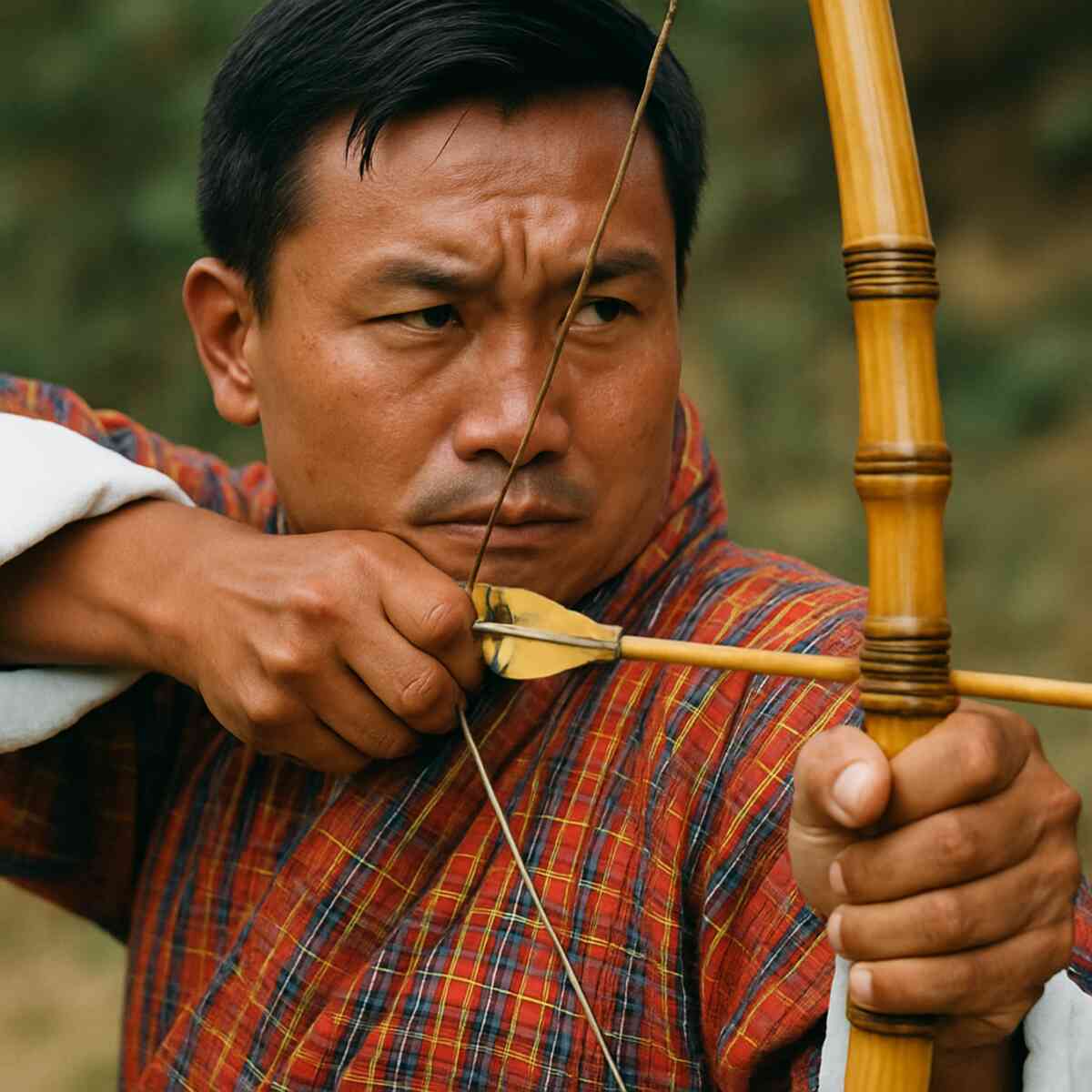
Archery, known locally as Dha, has been central to Bhutanese identity for centuries. Historically, the bow and arrow were the primary weapons of survival and defense. Legends recount how the gods themselves used bows to defeat malevolent spirits. During the 19th century, Bhutanese warriors relied heavily on their archery skills to repel Tibetan invasions and British colonial forces. The legendary Bhutanese leader Jigme Namgyal—father of the first King of Bhutan—famously used his masterful archery skills in battle, turning the bow into a symbol of national sovereignty and strength.
When Bhutan officially joined the United Nations in 1971, it sought to formalize its cultural identity on the global stage. It was during this momentous year that archery was officially declared the national game of bhutan.
However, the cultural significance of Bhutanese sports goes far beyond historical combat. Archery is a spiritual practice. Before major tournaments, local deities are invoked, and astrologers are consulted to determine the most auspicious days to play. Teams make offerings to the protective spirits of the land, ensuring that the bhutan national game remains a bridge between the physical and the spiritual realms.
The Mighty Bow: National Sport of Bhutan Equipment & Craftsmanship
To appreciate the game, one must understand the tools of the trade. The national sport of Bhutan equipment is a fascinating blend of ancient artisan craftsmanship and modern technological adoption.
Traditional Bamboo Bow Construction
For centuries, the Bhutanese relied exclusively on bows made from local bamboo. Traditional bamboo bow construction is an intricate art form passed down through generations.
- Harvesting the Bamboo: Artisans venture into the dense forests to select a specific type of high-altitude bamboo known for its flexibility and tensile strength. The bamboo must be harvested during specific lunar phases to ensure the sap content is ideal.
- Curing and Shaping: The raw bamboo is meticulously dried over smoky fires for weeks. It is then shaved and shaped. A traditional Bhutanese bow consists of two pieces of bamboo joined together at the grip with strong adhesives and tightly bound with natural fibers.
- Stringing: The bowstring is typically made from twisted nettle cords, silk, or animal sinew, tightly wound to create massive tension.
- The Arrows: Traditional arrows are crafted from special reeds, fitted with sharp metal arrowheads, and fletched with the feathers of wild pheasants or eagles to ensure a stable flight path.
Bhutanese Archery vs Compound Archery
In recent decades, modernization has inevitably influenced the sporting fields of Bhutan. Today, a heated, yet friendly, debate exists regarding Bhutanese archery vs compound archery.
While traditional bamboo bows require immense upper-body strength and a deep understanding of natural materials, modern compound bows—often imported from the United States—have taken the competitive scene by storm. Compound bows use a system of pulleys and cables, allowing the archer to hold a heavy draw weight with minimal physical strain while delivering the arrow at blistering speeds.
Many purists argue that the compound bow strips the game of its historical soul. However, the use of modern equipment has undeniably raised the competitive ceiling of the sport. Today, local village matches often still feature the beautiful, snapping sound of traditional bamboo, while high-stakes national tournaments almost exclusively utilize high-tech compound bows.
Hitting the Mark: Traditional Bhutanese Archery Rules & Gameplay
Watching a match is a thrilling, sometimes bewildering experience for outsiders. The traditional Bhutanese archery rules differ vastly from the Olympic standards you might see on television.
The Staggering Distance
In Olympic archery, the target is set at 70 meters. In Bhutanese archery, the distance is a staggering 145 meters (about 475 feet). At this distance, the target—a beautifully painted wooden plank called a Karay, measuring only about 3 feet tall and 11 inches wide—looks like a tiny colorful speck on the horizon.
Scoring and Gameplay
The rules are designed to test not only precision but endurance and mental fortitude.
- Team Structure: Two teams, each usually consisting of 11 players, face off.
- The Pitch: The archery range has two targets placed at opposite ends. Teams take turns shooting two arrows each from one end of the field to the other.
- Points System: Scoring is simple yet highly competitive.
- 3 points are awarded for a direct bullseye (the center of the target).
- 2 points for hitting any other part of the target board.
- 1 point if the arrow lands within a specific distance (usually an arrow’s length) of the target, provided no opponent’s arrow is closer.
- Winning the Match: A team must reach exactly 25 points to win a single game. However, points can be canceled out by the opposing team’s hits, making matches dynamic tugs-of-war that can last for hours, or even days.
Improving Accuracy in Himalayan Archery
Given the extreme distance, improving accuracy in Himalayan archery is considered a lifelong pursuit. Archers must factor in the high-altitude air density, rapidly shifting mountain winds, and the blinding glare of the sun.
Mastering the release requires a combination of perfect physical stance and deep mental calm. Older archers often teach younger generations to release the arrow exactly between heartbeats. To adjust for the wind, an archer’s teammates stand dangerously close to the target board at the far end of the range, shouting back instructions regarding wind direction and signaling where the previous arrow landed.
The Spectacle of the Range: Bhutanese Archery Singing and Dancing Rituals
A standard sporting event in the West might feature cheerleaders or a halftime show, but in Bhutan, the performance is woven directly into the gameplay. The Dha tournament social traditions are arguably as important as the archery itself.
The Celebratory Dance (Cham)
Every time an archer successfully hits the target, a magnificent ritual unfolds. His teammates at the target end will immediately form a circle, link arms, and perform a slow, rhythmic victory dance. These Bhutanese archery singing and dancing rituals involve high-pitched, melodic chanting, praising the archer’s skill, the favor of the gods, and the quality of the bow. They kick their legs in synchronized movements, their colorful traditional robes (the gho) swaying in the mountain breeze.
Psychological Warfare and Taunting
But the singing is not just for celebration; it is a highly refined form of psychological warfare. When an opposing archer steps up to the shooting line, the defending team will begin to sing distracting, mocking songs. They might question the archer’s manhood, make humorous remarks about his eyesight, or playfully insult his ancestors.
Furthermore, female supporters often line the sides of the pitch. These women, adorned in beautiful silk kiras, perform their own synchronized dances and songs, specifically designed to distract the opposing team’s shooters. The atmosphere is loud, raucous, entirely joyful, and undeniably communal.
Beyond the Bow: Exploring Khuru (Bhutanese Darts)
While archery is the undisputed king of Bhutanese sports, it is far from the only game in town. For those seeking an equally thrilling, slightly more accessible Bhutan game, there is Khuru.
What is Khuru?
Khuru is the traditional Bhutanese game of darts. However, if you are picturing a quiet game played in the corner of a dimly lit pub, you are in for a shock. The difference between Khuru and western darts is massive in scale, weight, and environment.
The Equipment
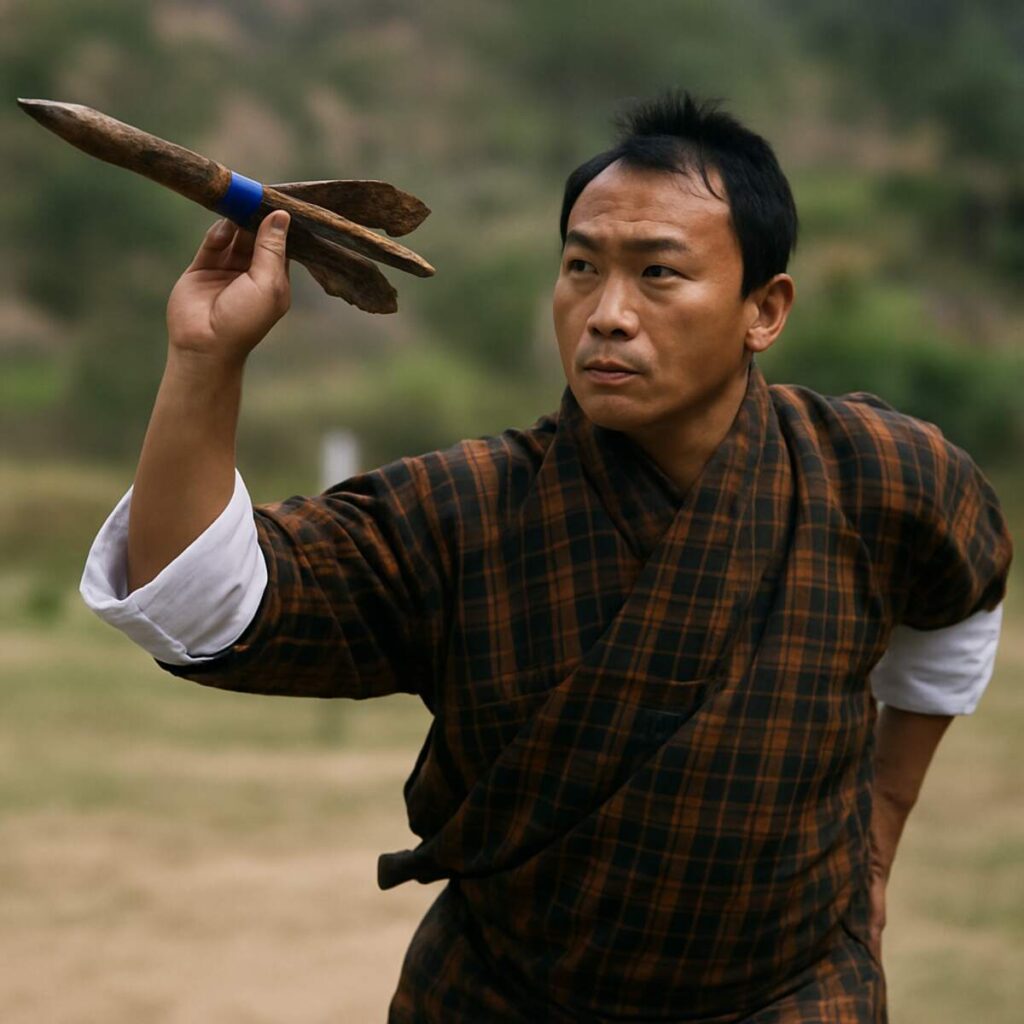
A Khuru dart is a heavy, formidable projectile. It is roughly a foot long, hand-carved from dense hardwood, and features a thick, sharp metal nail at the tip. The tail is heavily fletched with large feathers—often from a peacock or pheasant—to stabilize its flight. Because of the dart’s weight, throwing it requires significant full-body momentum.
How to Play Khuru Darts
Learning how to play Khuru darts involves mastering a dynamic, almost explosive throwing technique.
- The Range: Unlike indoor darts, Khuru is played outdoors on a specialized pitch. The distance between the thrower and the target is typically 20 to 30 meters.
- The Target: A small, painted wooden block driven into the ground, roughly the size of a large textbook.
- The Throw: Players take a running start before launching the heavy dart underhand or overhand on a high arc, aiming for it to plunge violently into the wooden block.
- Scoring: Similar to archery, points are awarded for hitting the target or landing closest to it. Matches are team-based and require reaching a set point limit.
Just like in archery, Khuru matches are accompanied by intense singing, dancing, and lively banter. It is a wildly popular game during local holidays because the equipment is cheaper and easier to manufacture than high-end compound bows, making it accessible to every village in the country.
Degor: The Himalayan Shot Put
Another beloved bhutan game is Degor. Often described by outsiders as a mix between shot put, horseshoes, and boules, Degor is a game of strategy, strength, and precision.
What is Degor?
Degor is played using a pair of flat, spherical stones. These stones are not standardized; instead, players spend years scouring riverbeds to find stones that perfectly fit the size of their hands and possess the right weight and balance.
Bhutanese Shot Put Rules Degor
Understanding the Bhutanese shot put rules Degor is quite simple, but mastering the game takes a lifetime.
- The Pitch: The game is played outdoors on a flat stretch of land. Two wooden pegs are driven into the ground about 20 meters apart.
- The Throw: Players use an underarm swing to toss their heavy stones toward the peg. The goal is to land the stone as close to the peg as possible.
- Strategy: Degor is a highly strategic game. Because the stones are heavy, players do not just aim for the peg; they actively throw their stones to smash into an opponent’s stone, knocking it out of the scoring zone.
- Scoring: At the end of the round, the team whose stone is closest to the peg scores a point.
Because Degor does not require the massive open space of archery, it is incredibly common to see groups of men playing it in monastery courtyards, village squares, and open pastures on late weekend afternoons.
The Social Fabric: Cultural Significance of Bhutanese Sports & Festivals
To view a Bhutan game simply as a sport is to misunderstand its purpose. The cultural significance of Bhutanese sports lies in their power to build and maintain the community spirit that is so vital to Bhutan’s philosophy of Gross National Happiness (GNH).
The Role of Sports in Gross National Happiness
Bhutan measures its progress not just by economic output, but by the well-being and happiness of its citizens. The four pillars of GNH include the preservation and promotion of culture. Traditional sports are a living, breathing manifestation of this pillar.
When a village gathers for an archery or Khuru match, social hierarchies melt away. A farmer might find himself on the same team as a government official or a local businessman. On the archery range, all men are equal under the eyes of the target.
Village Festivals and Traditional Games
Sports are inextricably linked to the country’s religious and social calendars. During Tsechus (annual religious festivals), the atmosphere is electric. After the solemn religious mask dances conclude in the Dzong (fortress), the entire community spills out into the fields for village festivals and traditional games.
These events serve vital social functions. They are venues for matchmaking, where young men and women from neighboring valleys can meet. They act as informal arenas for conflict resolution, where inter-village disputes are settled through friendly athletic rivalry rather than hostility. Copious amounts of traditional food, such as Ema Datshi (chilli and cheese), are shared, along with Ara, a potent, locally brewed rice wine that keeps the spirits high and the singing loud.
A Spectator’s Guide: Experiencing a Bhutan Game Safely
For travelers visiting Bhutan, witnessing these sports is an absolute must. However, because these games involve heavy projectiles and live weapons, attending a match requires a bit of insider knowledge.
Best Time to Watch Local Competitions
You can find an archery or dart match happening almost every weekend in Bhutan, but there are specific times when the atmosphere is truly magical.
- Losar (Bhutanese New Year): Usually falling in February or March, Losar is accompanied by massive national tournaments and local village sweepstakes. This is arguably the best time to watch local competitions.
- Coronation Day and National Day: November 1st and December 17th, respectively, feature high-stakes, incredibly festive matches.
- Weekends at Changlimithang Stadium: If you are in the capital city of Thimphu, the national stadium’s archery range is active almost every Saturday and Sunday. You can seamlessly walk up and watch the country’s best archers compete.
Safety Tips for Bhutanese Archery Spectators
Watching a Bhutan game is thrilling, but it comes with inherent risks. The arrows and darts fly at terrifying speeds. Here are essential safety tips for Bhutanese archery spectators:
- Never Cross the Field: This may sound obvious, but the sheer length of an archery range (145 meters) can make it seem like an open park. Never, under any circumstances, walk across the middle of an active pitch.
- Stay Behind the Safety Lines: Always stand behind the designated viewing areas or protective netting.
- Beware of Stray Arrows: Even the best archers miss. With compound bows, an arrow that misses the target can ricochet off stones and travel in unpredictable directions. Keep your eyes on the archer who is shooting.
- Follow Local Cues: If you see locals suddenly duck or move back, do exactly as they do without hesitation.
- Respect the Players: Feel free to take photographs (locals are incredibly proud of their sport and usually love being photographed), but do not use a flash, and do not distract an archer who is at full draw.
The Spirit of Play: Other Traditional Games
While Archery, Khuru, and Degor dominate the landscape, the Bhutanese community spirit is also fostered by a variety of smaller, traditional games that deserve a brief mention:
- Sokomandu: A highly physical game similar to javelin, where a long, thin stick is thrown for distance. It requires immense core strength and a perfect release angle.
- Pundo: A true test of brute strength, Pundo is a shot put game played with a heavy round stone, but unlike Degor, it is thrown directly from the shoulder for maximum distance rather than accuracy.
- Jigdum: A game played with a specialized, two-pronged wooden instrument thrown at a target, traditionally used by herdsmen to pass the time while watching over their yaks.
These games, often played by children and teenagers, serve as the training ground for the physical coordination and competitive spirit required for the major national sports.
Conclusion: More Than Just a Game
A traditional Bhutan game is a profound reflection of the nation itself. It is a harmonious blend of intense concentration, profound spirituality, joyful celebration, and deep-rooted community bonding.
From the meticulous art of traditional bamboo bow construction to the raucous Bhutanese archery rituals of singing and dancing, every aspect of these sports is designed to bring people together. Whether it is the soaring flight of an arrow in the national game of bhutan, the heavy thud of a Khuru dart, or the strategic clack of Degor stones, these sports are the living heartbeat of the Himalayas.
For the Bhutanese, the ultimate goal is not merely to defeat an opponent, but to participate in a shared cultural legacy. For any traveler lucky enough to stand on the sidelines, cheering alongside the locals as a whistling arrow finds its mark, the experience is a profound reminder that the truest measure of a community is how it plays together. So, the next time you find yourself wandering the majestic valleys of this Himalayan kingdom, listen for the distant sound of singing—it will inevitably lead you to the joyous, unforgettable spectacle of a Bhutanese sporting arena.
