



Picture this: You are cruising down the highway, enjoying a clear, sunny day, listening to your favorite podcast. Suddenly, a dump truck ahead of you hits a bump, launching a tiny, rogue pebble into the air. With a sharp, startling SMACK, the rock collides with your windshield. Get the Best information about car glass repair.
You flinch, hit the wipers out of pure reflex, and there it is—a star-shaped blemish right in your line of sight.
For many drivers, auto glass damage is an annoying but seemingly minor inconvenience. It is incredibly tempting to ignore a small chip or crack, hoping it will just magically disappear or, at the very least, not get any worse. However, your vehicle’s glass is an integral component of its structural integrity and safety systems. Knowing exactly when to seek professional car glass repair can save you money, preserve your vehicle’s advanced technology, and most importantly, protect your life.
In this comprehensive guide, we will explore everything you need to know about the world of auto glass. From understanding the materials that make up your vehicle’s windows to decoding the complexities of modern safety calibrations, this article is your ultimate resource for making informed decisions about windshield repair and replacement.
Table of Contents
Understanding Your Vehicle’s Glass: More Than Just a Window
Before diving into repair strategies, it is crucial to understand that not all glass on your car is created equal. The glass used in automobiles is highly engineered to withstand extreme pressures, temperature fluctuations, and direct impacts.
When discussing auto glass, we are primarily looking at two distinct types: laminated and tempered glass. Understanding the difference between laminated vs tempered auto glass is the first step in knowing how to handle damage.
Laminated Glass: The Windshield’s Shield
Your windshield is made of laminated glass. This is a specialized safety glass constructed by sandwiching a thin, tough layer of Polyvinyl Butyral (PVB) plastic between two sheets of standard glass. The layers are bonded together under immense heat and pressure.
- How it works: When an object strikes laminated glass, the outer layer of glass may break, but the flexible PVB interlayer holds the shattered pieces together. This prevents shards of glass from flying into the cabin and blinding or injuring the occupants.
- Why it matters: Because of this layered construction, minor damage to the outer layer can often be repaired without needing to replace the entire windshield.
Tempered Glass: The Side and Rear Windows
The side windows, rear windshield, and sunroof are typically made of tempered glass. Tempered glass is created through a rapid heating and cooling process that makes it up to four times stronger than standard glass.
- How it works: When tempered glass sustains a severe impact, it is designed to shatter completely into hundreds of small, dull, pebble-like cubes rather than sharp, jagged shards.
- Why it matters: Because it shatters completely upon structural failure, tempered glass cannot be repaired. If a side window breaks, it requires a complete replacement.
(Note: Some luxury and modern vehicles are now using laminated glass for side windows to improve sound insulation and rollover safety. Always check your vehicle’s specifications).
The Hidden Dangers: Safety Risks of Driving with Cracked Glass
It is easy to look at a small crack on the passenger side and think, “I’ll deal with that next month.” However, ignoring auto glass damage is a dangerous gamble. The safety risks of driving with cracked glass are severe and often underestimated by the average driver.
1. Compromised Structural Integrity
In modern vehicles, the windshield is not just a windbreak; it is a critical structural component. In the event of a rollover accident, the windshield provides up to 45% of the cabin’s structural integrity. A compromised windshield is significantly weaker and can buckle under pressure, allowing the roof to crush inward and severely injure the occupants.
2. Flawed Airbag Deployment
Your passenger-side airbag relies heavily on the windshield. When the airbag deploys during a collision, it expands upward at roughly 150 to 200 miles per hour, bouncing off the inside of the windshield to cushion the passenger. If the windshield is already cracked, the explosive force of the airbag can blow the windshield entirely out of the frame. This removes the backboard the airbag needs, rendering it ineffective and leaving the passenger unprotected.
3. Visual Impairment and Glare
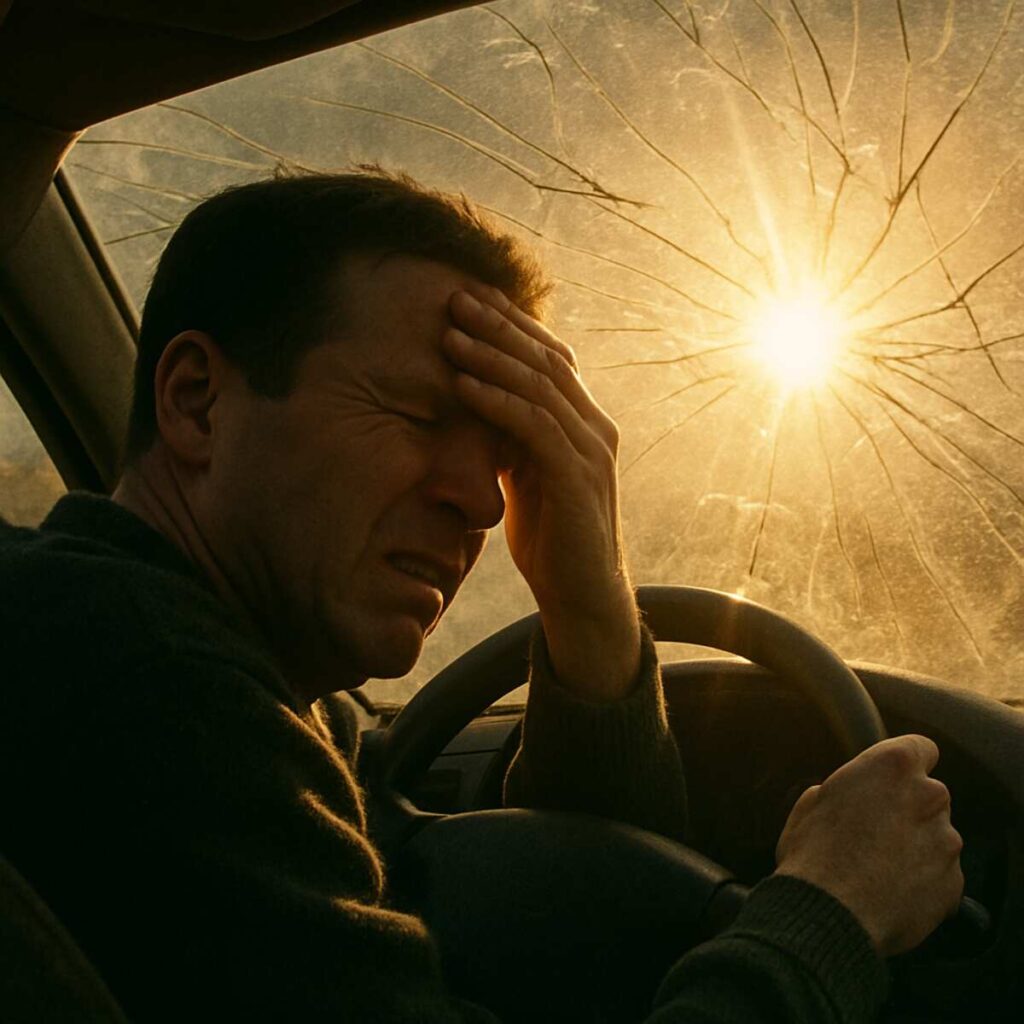
Even a small chip can act like a prism. When direct sunlight or the headlights of oncoming traffic hit a chip or crack at the right angle, the light scatters. This sudden, blinding glare can momentarily obscure your vision, leading to an accident.
The Urgency of Action: Preventing Stone Chip Damage Spreading
If you have a chip, time is your worst enemy. A minor bullseye chip can rapidly spiderweb into a foot-long crack, turning a cheap repair into a costly replacement. Preventing stone chip damage spreading requires immediate awareness of the environmental factors that exacerbate glass damage.
What Causes a Crack to Spread?
- Thermal Shock: Glass expands in the heat and contracts in the cold. If you park your car in the blazing summer sun and then blast the air conditioning, the rapid temperature change will cause the glass to flex. The weak point (the chip) will crack under this stress. The same applies in winter when blasting the defroster on a frozen windshield.
- Road Vibrations: Potholes, speed bumps, uneven gravel roads, and even slamming your car door too hard create vibrations and pressure spikes inside the cabin that travel through the glass, encouraging a chip to run.
- Dirt and Moisture: When it rains, water seeps into the micro-cracks of a chip. If the temperature drops below freezing, that water turns to ice, expanding and forcing the crack open further. Additionally, dirt creeping into a chip makes it much harder for a professional to achieve a clean, invisible repair later.
Immediate Actionable Tips:
- Seal it temporarily: Place a small piece of clear packing tape over the chip to keep dirt and moisture out until you can get it fixed. (Do not use super glue!).
- Avoid the car wash: The high-pressure water jets and extreme temperature changes of a commercial car wash will almost certainly cause a chip to spread.
- Regulate temperature slowly: Do not blast the AC or the defroster on maximum immediately. Gradually change the cabin temperature.
- Close doors gently: Roll down a window an inch before closing your car door to prevent the cabin pressure spike from pushing against the windshield.
Assessing the Damage: Types of Windshield Damage
Before deciding on a course of action, you must understand the type of damage your glass has sustained. Professionals categorize windshield damage into several distinct types, which dictate whether a repair is viable.
- Bullseye: A circular break with a distinct pit in the center. These are generally the easiest to repair if caught early.
- Half-Moon: Similar to a bullseye but not a complete circle.
- Star Break: A small central point of impact with multiple legs or cracks radiating outward, resembling a star. These are highly susceptible to spreading quickly.
- Combination Break: A nasty mix of a bullseye and a star break.
- Spiderweb Cracks: A series of dense, intersecting cracks resulting from a severe impact. Fixing spiderweb cracks in auto glass is notoriously difficult. If the spiderwebbing is localized to a very small area (the size of a dime), it might be repairable by a highly skilled technician. However, extensive spiderweb cracks severely compromise the PVB layer and almost always necessitate a full replacement.
The DIY Route: Can You Fix It Yourself?
With the rise of online tutorials, many drivers wonder how to fix cracked car window damage themselves to save a few dollars. Walk into any auto parts store, and you will see shelves lined with various solutions. But is a DIY windshield chip repair kit worth it?
How DIY Repair Kits Work
A standard off-the-shelf windshield chip repair kit usually comes with a small plastic pedestal, a syringe or plunger mechanism, a razor blade, curing film, and a small bottle of resin.
The basic step by step windshield patch application for a DIY kit generally involves:
- Cleaning the area: Using a pin or razor to clear loose glass shards from the impact pit.
- Mounting the pedestal: Attaching an adhesive seal and a plastic pedestal directly over the chip.
- Applying the resin: Squeezing a few drops of resin into the pedestal.
- Creating a vacuum: Using the provided syringe to pull air out of the break, creating a vacuum so the resin can flow into the micro-cracks.
- Pressurizing: Pushing the syringe down to force the resin deep into the crack.
- Curing: Removing the pedestal, applying a clear curing strip over the wet resin, and parking the car in direct sunlight to allow UV rays to cure it.
- Scraping: Scraping off the excess dried resin with a razor blade.
The Limitations of DIY Car Glass Repair
While DIY kits can temporarily stop a tiny chip from spreading, they come with significant drawbacks compared to professional services.
- Inferior Resin Quality: The resin in a $15 kit is often thin and prone to yellowing over time. It lacks the structural bonding agents found in professional-grade materials.
- Weak Vacuum Systems: A plastic syringe simply cannot generate the same level of vacuum pressure as a professional technician’s pneumatic bridge. This means tiny air bubbles are often left trapped inside the crack, leaving the repair highly visible and structurally weak.
- One-Shot Deal: If you mess up a DIY repair (e.g., the resin cures before it fills the crack entirely), you cannot try again. The resin seals the entry point, meaning a professional technician can no longer fix it. Your only remaining option will be a full, expensive windshield replacement.
The Verdict on DIY: Use a DIY kit only if the chip is incredibly small, far out of the driver’s line of sight, and you absolutely cannot afford professional car glass repair at the moment. Otherwise, leave it to the pros.
When to Seek Professional Glass Repair
Knowing where to draw the line between ignoring it, DIY-ing it, or calling in an expert is vital. You should seek professional windshield repair immediately if your damage meets any of the following criteria:
1. The Size Rule
The general rule of thumb in the auto glass industry is the “Dollar Bill and Quarter Rule.”
- If a chip can be completely covered by a U.S. quarter, it is usually repairable.
- If a single crack is shorter than a dollar bill (about 6 inches), a skilled technician can likely repair it.
- If the damage exceeds these sizes, a full replacement is generally required.
2. The Location Rule
Location is just as critical as size. You must seek professional help—often leaning toward a full replacement—if the damage is:
- In the Driver’s Line of Sight: If the chip is directly in front of the steering wheel, even a perfect repair can leave a slight distortion or blur in the glass. This distortion can distract the driver or obscure small hazards on the road.
- At the Edge of the Windshield: Cracks that touch the outer edge of the windshield compromise the factory seal. These are highly dangerous and usually mean the windshield must be replaced to restore structural integrity.
- Over Sensors or Cameras: Modern cars have rain sensors, lane-departure cameras, and automatic braking lasers mounted behind the windshield. A crack or a blurry repair over these sensors will cause the safety systems to fail.
3. The Depth Rule
If the rock struck your vehicle hard enough to penetrate the outer layer of glass, puncture the PVB plastic interlayer, and damage the inner layer of glass, it cannot be repaired. A professional technician will use a specialized probe to test the depth of the impact before attempting a repair.
Inside the Professional Windshield Repair Process
When you hire an expert for your car glass repair, you are paying for advanced equipment, superior materials, and specialized knowledge. The professional process goes far beyond what a DIY kit can achieve.
The Professional Tool Kit
A certified technician will use a precision-machined injector tool—often referred to as a “bridge.” This tool mounts securely to the glass and uses a mechanical or pneumatic pump to alternate between pulling a massive vacuum (extracting every microscopic air bubble from the crack) and applying intense pressure (forcing the resin into the absolute deepest extremities of the star break).
High-Quality Optical Grade Resin
Professionals do not use a one-size-fits-all liquid. They use high-quality optical grade resin. In fact, a skilled technician will carry multiple types of resins with different viscosities (thicknesses). They will choose a thinner resin for tight, hairline cracks and a thicker resin for large bullseye pits. These professional resins are engineered to match the exact light-refracting index of auto glass, making the repair nearly invisible to the naked eye. They also contain UV inhibitors to prevent yellowing over time.
Curing and Finishing
While a DIY kit relies on the sun (which is unreliable on a cloudy day), professionals use high-intensity UV lamps to cure the resin. The average time for windshield resin to cure under a professional UV lamp is remarkably fast—usually between 3 to 5 minutes. Once cured, the technician uses specialized pit polish to smooth the surface, ensuring your windshield wipers glide over the repaired area without catching or streaking.
The Importance of Certification
Not all auto glass shops operate at the same standard. When choosing a shop, look for professional windshield technician certifications. Technicians certified by the Auto Glass Safety Council (AGSC) or the National Glass Association (NGA) have undergone rigorous training in chemistry, structural safety, and ethical repair practices. A certified tech knows when a repair is safe and when pushing for a replacement is legally and morally required to protect the driver.
The Big Decision: Repair vs. Replacement
If the technician evaluates your vehicle and declares that a repair is impossible due to the size, depth, or location of the damage, you are looking at a full replacement. This brings up the inevitable anxiety regarding the windshield replacement vs repair cost.
Breaking Down the Costs
Windshield Repair:
- Cost: Typically ranges from $50 to $150, depending on the severity of the chip and your location.
- Time: Takes about 30 to 45 minutes from start to finish.
- Environmental Impact: Excellent. Repairing glass keeps non-recyclable laminated windshields out of landfills.
Windshield Replacement:
- Cost: Varies wildly based on the make and model of the car. An older, basic commuter car might cost $250 to $400. However, a modern luxury SUV loaded with sensors, heated glass, and heads-up displays (HUD) can easily cost between $800 and $1,500+.
- Time: Takes roughly 1 to 2 hours for the physical installation, plus an additional 1 to 3 hours of “Safe Drive-Away Time” (SDAT) to allow the urethane adhesive to cure enough to safely hold the glass in a crash.
- Environmental Impact: High. Old windshields are notoriously difficult to recycle due to the PVB plastic layer, meaning most end up in landfills.
Ultimately, repairing is always the preferred first option. It is cheaper, faster, and maintains the original factory seal of the windshield. However, if safety dictates a replacement, do not compromise.
Choosing the Right Replacement Glass: OEM vs Aftermarket Auto Glass
If you are forced into a windshield replacement, your repair shop or insurance company will ask you a critical question: Do you want OEM or aftermarket glass? Understanding the difference between OEM vs aftermarket auto glass is vital for the safety, resale value, and technological functionality of your vehicle.
OEM (Original Equipment Manufacturer) Glass
OEM glass is fabricated by the exact same company that made the original windshield for your car’s manufacturer (e.g., Pilkington, Saint-Gobain Sekurit, PGW).
- Pros: It is identical to the glass your car rolled off the assembly line with. It has the exact same thickness, tint, durability, and acoustic properties. It will also feature the automaker’s logo stamped in the corner. For vehicles with complex safety cameras, OEM is heavily recommended (and sometimes required) to ensure perfect optical clarity for the sensors.
- Cons: It is significantly more expensive. Many insurance companies will not cover the full cost of OEM glass unless you have a specific rider on your policy or your car is less than a year or two old.
OEE (Original Equipment Equivalent) / Aftermarket Glass
Aftermarket glass is made by auto glass manufacturers that do not hold the original contract with your car manufacturer.
- Pros: It is much more affordable and widely available. Reputable aftermarket glass must still meet minimum Department of Transportation (DOT) safety standards.
- Cons: Because aftermarket companies cannot violate OEM patents, their glass might differ slightly in thickness, curvature, or color. While minor, these differences can occasionally cause wind noise, slight visual distortion, or complications when recalibrating modern safety sensors. It will not have the carmaker’s logo.
Expert Advice: If you are driving a leased vehicle, check your lease agreement immediately. Most leases require you to return the car with OEM glass; if you use aftermarket glass, they will charge you for a brand-new OEM windshield when you turn the car in.
The Technological Catch: ADAS Recalibration After Windshield Replacement
Ten years ago, a windshield replacement was a strictly mechanical job: cut out the old glass, glue in the new one, and drive away. Today, a windshield is a highly sophisticated technological hub. This introduces the most critical (and often most expensive) part of modern auto glass care: ADAS recalibration after windshield replacement.
What is ADAS?
ADAS stands for Advanced Driver Assistance Systems. These are the active safety features that keep you alive on the road. Features include:
- Lane Departure Warning / Lane Keep Assist
- Forward Collision Warning
- Automatic Emergency Braking
- Adaptive Cruise Control
- Rain-sensing Wipers
- Traffic Sign Recognition
Most of these systems rely on a forward-facing camera mounted on the windshield, usually situated behind the rearview mirror.
Why Recalibration is Non-Negotiable
When a windshield is replaced, the forward-facing camera is temporarily removed and remounted onto the new glass. Even if the technician is a millimeter off, or if the new glass has a microscopic difference in pitch or optical clarity, the camera’s line of sight is altered.
Imagine a camera looking down the highway. If it is misaligned by just one single degree, the camera’s focal point will be off by over 50 feet when looking at an object 100 yards away.
- The Result: Your car might think you are drifting out of your lane when you are perfectly centered, causing the steering wheel to violently jerk you into oncoming traffic. Or, the automatic emergency braking system might fail to detect a stopped car ahead, resulting in a catastrophic rear-end collision.
The Recalibration Process
Professional auto glass facilities use highly advanced software and physical targeting boards to perform recalibrations.
- Static Recalibration: Done inside a controlled shop environment. The technician places large, complex target boards at exact distances and heights from the vehicle, plugging a computer into the car’s OBD-II port to tell the camera to “learn” its new center point.
- Dynamic Recalibration: The technician plugs a diagnostic computer into the vehicle and drives it on clearly marked roads at specific speeds. The camera uses lane markers and street signs to reorient itself.
Recalibration adds time and expense to a replacement (often costing $200 to $600 just for the recalibration), but it is absolutely vital. Never allow a glass shop to replace a modern windshield without guaranteeing proper ADAS recalibration.
Navigating the Logistics: Insurance and Mobile Services
The financial and logistical hurdles of auto glass repair often deter people from getting the help they need. Fortunately, the auto glass industry is highly accommodating.
Does Insurance Cover Windshield Replacement and Repair?
One of the most common questions drivers ask is, “Does insurance cover windshield replacement or repair?” The answer largely depends on your specific auto insurance policy and the state in which you live.
- Comprehensive Coverage: Auto glass damage is categorized under the comprehensive portion of your auto insurance policy (which covers “acts of god,” vandalism, theft, and falling objects—like rocks). If you only have basic liability insurance, you will be paying completely out of pocket.
- Repair vs. Replace: To encourage drivers to fix minor damage before it becomes a major structural issue, almost all insurance companies will waive your deductible completely if you opt for a windshield repair. That means the repair is 100% free to you.
- Deductibles for Replacement: If you need a full replacement, you will generally have to pay your comprehensive deductible (often $250 to $500). However, some insurance companies offer specialized “glass riders” with a $0 deductible for an extra few dollars a month.
- Zero-Deductible States: If you live in Florida, Kentucky, or South Carolina, you are in luck. By law, if you carry comprehensive insurance in these states, insurance companies must waive the deductible for windshield replacements. Arizona, Massachusetts, and New York also offer specific separate glass coverage with no deductible requirements.
Tip: Before paying out of pocket, always call your insurance agent. Auto glass claims are considered “no-fault” claims and generally do not cause your monthly premiums to skyrocket.
The Rise of Mobile Auto Glass Service Benefits
Finding the time to sit in a waiting room for three hours is a luxury many do not have. This is where mobile auto glass service benefits shine.
Most major glass repair companies now operate fleets of mobile repair vans. A certified technician will come to your home, your office parking lot, or even a shopping mall to perform the repair or replacement on-site.
Key Benefits:
- Extreme Convenience: You do not have to take time off work. The technician fixes the car while you continue your day.
- Increased Safety: If your windshield is severely smashed, driving it to a shop is illegal and dangerous. Mobile service keeps a dangerous vehicle off the road.
- No Extra Cost: Most companies do not charge a premium for mobile service; it is baked into their standard pricing model to remain competitive.
(Note on mobile ADAS recalibration: While mobile repairs and physical replacements are easy, not all mobile vans are equipped for complex ADAS recalibration. Static recalibrations require a perfectly level floor and controlled lighting, which cannot be achieved in a driveway. You may still need to visit the shop if your vehicle requires static recalibration).
A Maintenance Mindset: Prolonging the Life of Your Auto Glass
While you cannot always avoid rogue rocks on the highway, you can adopt a maintenance mindset to protect your auto glass and minimize the chances of a catastrophic crack.
- Maintain Your Wiper Blades: Windshield wipers should be replaced every 6 to 12 months. When the rubber degrades, the hard plastic or metal arm of the wiper drags directly across the glass. Over time, this causes deep, permanent scratches across your line of sight. These scratches catch the glare of headlights at night, acting like a cracked windshield and blinding you.
- Keep Your Distance: The most common cause of stone chips is tailgating. Large commercial vehicles, dump trucks, and cars with oversized off-road tires kick up debris at an alarming rate. Maintain at least a three-second following distance, and give construction vehicles an even wider berth.
- Mind the Temperature: As discussed earlier, avoid thermal shock. Do not wash your car with cold water on a 100-degree day, and do not pour boiling water on a frozen windshield to melt the ice (a surprisingly common and disastrous mistake).
- Inspect Regularly: Make it a habit to inspect your windshield, side glass, and rear window when you wash your car. Catching a micro-chip before the winter freeze sets in is the easiest way to avoid a full replacement.
Conclusion: Clarity and Safety Go Hand in Hand
Your vehicle’s windshield is a marvel of modern engineering. It is a structural pillar, a shield against the elements, and the lens through which your car’s advanced safety systems view the world. Treating a chip or crack as a mere cosmetic annoyance is a dangerous oversight.
Knowing when to seek professional car glass repair comes down to vigilance and prompt action. Remember the golden rules: assess the damage immediately, protect the chip from dirt and moisture, and never underestimate the urgency of a repair. Whether you are dealing with a tiny bullseye that needs a quick injection of high-quality optical grade resin, or a massive spiderweb crack that demands a full OEM replacement and ADAS recalibration, prioritize your safety above all else.
By utilizing professional services, leveraging your insurance coverage, and understanding the intricate technology embedded in your auto glass, you ensure that the view through your windshield remains crystal clear—and that you and your passengers remain safe on every journey. Don’t wait for that tiny chip to become a major crisis; take action today and drive with confidence.
