


Tired of the same old game of Solitaire? What if you could play a version that’s less about random luck and more about solving a satisfying puzzle? Meet Double Scorpion. Using two standard 52-card decks shuffled together, this game challenges you to untangle a seemingly chaotic layout of 104 cards into perfect, orderly stacks. To learn more, check out akongcuan
Your primary mission is straightforward. The goal of Double Scorpion is to create eight complete stacks of cards, one for each suit, arranged in order from King down to Ace. Think of it like sorting laundry: you want one perfect pile for all the Hearts, another for all the Spades, and so on, each neatly arranged from King all the way down to the Ace.
Each time you successfully build one of these full King-to-Ace sequences, you get to remove it from the play area. This not only clears valuable space but also serves as a satisfying milestone on your path to victory.
Table of Contents
How to Set Up the Game: Your First Double Scorpion Layout
Getting a game of Double Scorpion started is quick and easy. Your first goal is to create the main playing area, known as the tableau. This is where all the action will happen. Don’t worry about perfection on your first try; just follow these simple steps, and you’ll have a perfect layout every time.
To begin, you’ll need two standard 52-card decks shuffled together.
- Deal ten columns of seven cards each, all face-down. This large grid is your tableau.
- Go back to the first seven columns and deal one more card, face-up, on top of each.
- Finally, take the remaining 27 cards and set them aside in a single face-down pile. This is your stock, which you’ll use later if you get stuck.
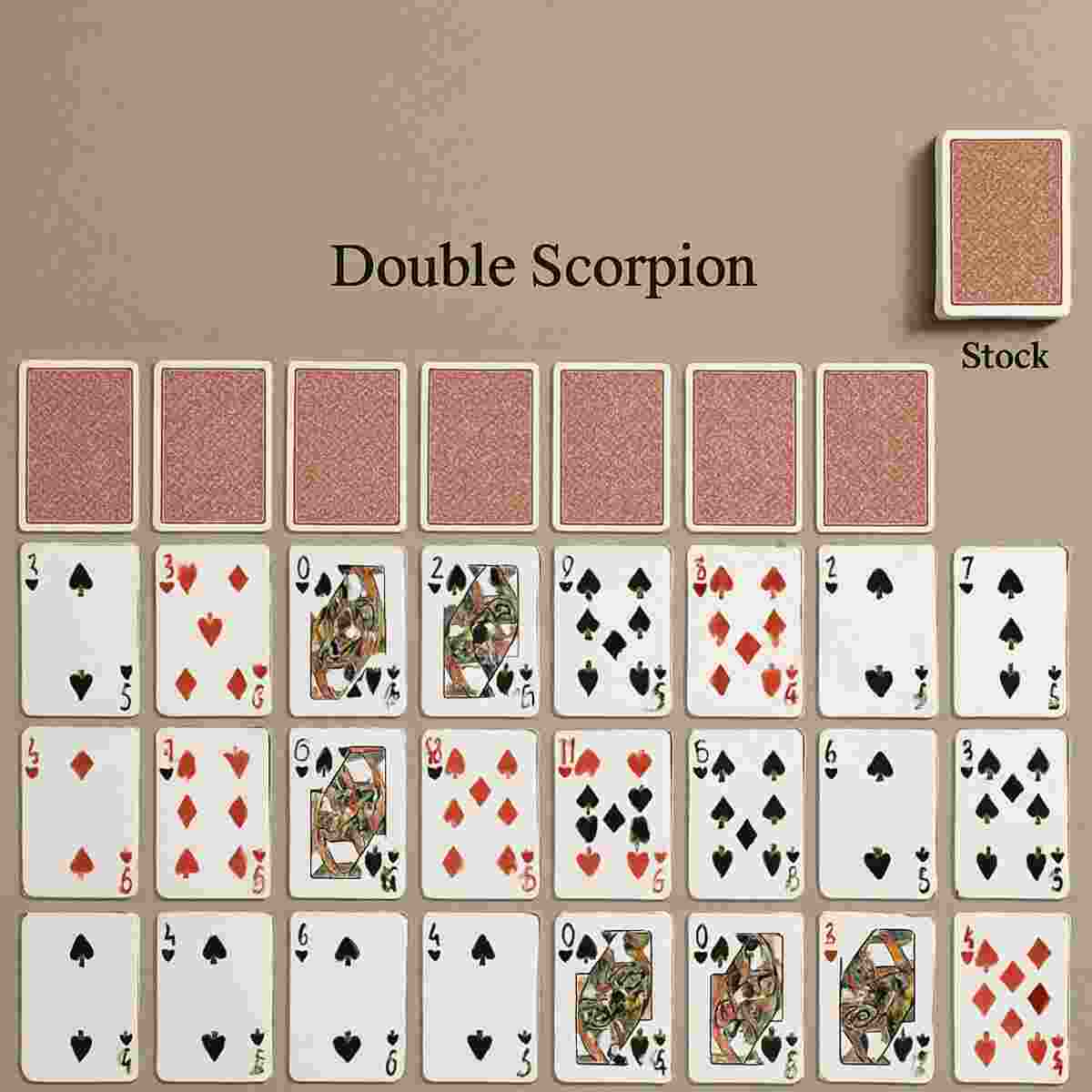
Once you’re done, your setup should look like the image below. You’ll have seven columns with eight cards (the top one face-up) and three columns with seven cards (all face-down). This seemingly jumbled layout is the puzzle you’re about to solve.
The Most Important Rule: How to Move Cards in Double Scorpion
The key to solving the puzzle of Double Scorpion lies in one simple but powerful rule. You can move any face-up card onto another face-up card as long as it is the same suit and one rank higher. For example, you can place a 7 of Spades directly onto an 8 of Spades, or a Queen of Hearts onto a King of Hearts. This is how you begin to build the orderly stacks you need to win the game.
Now, here’s the twist that makes Double Scorpion so interesting. When you decide to move a card, you must also take all the cards currently sitting on top of it. It doesn’t matter what suit or rank those other cards are—they just come along for the ride as a single block.
Think of it like lifting a stack of books by grabbing one from the middle; everything above the book you grab comes with it. If your 7 of Spades has a random 2 of Clubs and a King of Diamonds on top of it, that entire three-card stack moves together when you place the 7 of Spades on the 8 of Spades. The 2 of Clubs and King of Diamonds will now be sitting on top of your new sequence.
This means when you’re scanning the tableau for your next play, you only need to focus on two cards: the card you want to move and the card you want to place it on. Mastering this one rule is the first step in your Double Scorpion strategy. Every move you make brings you closer to organizing the chaos and uncovering the face-down cards hidden underneath.
Uncovering Hidden Cards: How to Reveal What’s Underneath
As you shift stacks around the board, you will eventually uncover one of the face-down cards. The rule here is simple: once a face-down card has nothing on top of it, you get to flip it over. This immediately brings a new, potentially useful card into the game, giving you fresh options for building your sequences.
Revealing these hidden cards should become your primary objective. Think of each face-down card as a locked treasure chest; uncovering it gives you a new piece to solve the puzzle. One of the best tips for winning is to always prioritize moves that will free up one of these cards, even if another move looks temporarily better.
Making progress is all about creating more possibilities, and that’s exactly what flipping cards does. With every stack you move, ask yourself, “Will this help me reveal a new card?” Eventually, you might move so many cards that you clear a column entirely, which opens up a powerful new opportunity.
The Power of an Empty Column: What to Do With Open Spaces
So, you’ve successfully cleared an entire column—congratulations! That empty space is now the most powerful spot on the board, but it comes with one very important restriction. Per the double scorpion empty column rule, only a King can be moved into an empty column. You cannot start a new stack with a Jack, a 6, or any other card. The space must wait for a King.
This rule makes empty columns the most valuable real estate in the game. Once you have an open column, you can move any available King into it, along with the entire stack of cards sitting on top of that King. This is a huge advantage, as it allows you to shift long, inconvenient stacks out of the way to uncover the cards trapped beneath them. Prioritizing an empty column is a key part of any successful scorpion solitaire two decks strategy.
It gives you the breathing room needed to reorganize the board and solve the puzzle. But what happens when you’ve made all the moves you can, and you’re still stuck? That’s when you turn to your last few cards for help.
What to Do When You’re Stuck: Using the Last 3 Cards
Sooner or later, you’ll scan the board and realize there are no legal moves left. This moment is exactly what those last three cards are for. When you are certain you cannot move another card, you can use this final bit of help to shake things up.
To play these cards, deal one card face-up directly onto the top of each of the first three columns. These three new cards are now in play, potentially creating new moves that can help you untangle the board. This simple action is a core part of the double scorpion rules and setup, giving you one last chance.
Be warned: you only get to do this once per game. After you’ve dealt these three cards, there’s no more help coming from the sidelines. You must use the cards on the table to finish the game.
How Do You Actually Win? Building and Removing a Completed Suit
The real magic of Double Scorpion happens when you assemble a perfect, unbroken sequence of cards. Your immediate goal is to build a full suit within a single column, starting with a King at the base and ending with an Ace on top (King, Queen, Jack, 10… all the way down to the Ace). When you finally place that Ace onto the 2, you have a complete 13-card stack, and you’ve achieved a major milestone in the game.
Once you’ve built a complete K-A sequence, you get a big reward: you can remove it from play. Simply pick up the entire 13-card stack and move it off to the side. These completed stacks are your foundations, and they represent your progress toward winning. Clearing a suit from the main playing area (the tableau) not only feels great, but it also frees up crucial cards that might have been trapped underneath, making it easier to solve the rest of the puzzle.

Winning the game is as simple as that—multiplied by eight. Since you’re playing with two decks, your final objective is to create eight foundation piles, two for each suit. The game is won when you’ve successfully moved all 104 cards into these orderly stacks, leaving the tableau empty. While it takes practice, a few key pointers can help you get there faster.
3 Simple Tips to Help You Win Your First Game
Double Scorpion can look like a hopeless tangle of cards at first, but a little bit of smart thinking can quickly turn chaos into order. While luck plays a part, your decisions matter most. Focusing on the right moves is the secret to getting unstuck in two deck scorpion and building those winning foundation piles.
- Always Prioritize Uncovering Cards. Your most powerful move is almost always one that flips a face-down card. Every new card you reveal gives you more information and more options to work with. If you have a choice between two moves, pick the one that lets you turn over a hidden card from the tableau.
- Create Empty Columns Early. An empty column is the most valuable real estate in the game because it’s the only place you can legally move a King. Freeing up Kings is essential to building your foundations, so work to clear out a column as soon as you can. Once empty, you can use it to park a King (and the stack below it) that’s blocking other important cards.
- Don’t Fear Messy Stacks. The core rule of Scorpion—moving cards of any suit along with the one you want—often creates disorganized-looking stacks. Don’t let that stop you! It’s perfectly fine to move a stack with a random 2 of Clubs and 9 of Spades on it if it helps you achieve a better goal, like uncovering a card or emptying a column. This bit of temporary mess is a core part of any good scorpion solitaire two decks strategy.
Double Scorpion vs. Regular Scorpion: What’s the Real Difference?
You might be wondering if there’s a “Single” Scorpion, and the answer is yes! Double Scorpion is simply the bigger, more sprawling version of a classic solitaire game called, simply, Scorpion. Both versions are part of the spider solitaire family of games and share the same core rule: you can move any face-up card to build down by suit, dragging the whole stack on top of it along for the ride. If you know how to play one, you essentially know how to play the other.
The real difference in the double scorpion vs scorpion solitaire debate comes down to scale. Standard Scorpion uses one deck dealt into seven columns, tasking you with building just four suits from King to Ace. As a two deck scorpion solitaire game, the “double” version uses two full decks, a wider layout of ten columns, and requires you to complete all eight suits. This larger setup creates a deeper, more involved puzzle right from the initial deal.
A game of Double Scorpion typically takes longer and requires more forward thinking. With twice as many cards in play, you have more opportunities to get blocked, but also more potential solutions to uncover. The sheer size of the puzzle can feel daunting, leading many players to ask if every game is even winnable.
Is Double Scorpion Always Solvable? (And Why You Shouldn’t Worry)
That big, messy layout can certainly look intimidating, raising a very fair question: is Double Scorpion always solvable? The straightforward answer is no. Much like classic solitaire, the random luck of the shuffle means some deals are simply impossible to win from the very start. A key card you need might be buried permanently at the bottom of a column with no way to get to it.
But this is precisely what makes the game so compelling. Instead of focusing only on winning, it’s more rewarding to think of Double Scorpion as a puzzle to be solved. The real satisfaction comes not just from a victory, but from making a series of smart moves to untangle a difficult position. Applying a good strategy is less about guaranteeing a win and more about playing your best possible game with the cards you were dealt.
Ultimately, your goal is to see how much order you can create from the initial chaos. When you shift your focus from “winning” to “solving,” every game becomes an enjoyable mental exercise. If you find yourself loving this style of thoughtful, strategic card puzzle, you’re in luck—there are many other great games out there that offer a similar challenge.
What to Play Next: 3 More “Thinking” Solitaire Games
You’ve successfully navigated the chaotic shuffle of a Double Scorpion layout and now see the elegant puzzle hidden within. Where you once saw a random jumble of cards, you now recognize the paths to victory, understanding the unique power of moving an entire stack just by grabbing the right card. This single skill has unlocked a new way to look at solitaire.
Your journey doesn’t have to end here. Your understanding of Double Scorpion makes you perfectly prepared to explore the wider spider solitaire family of games. If you enjoyed managing two decks and building suits, Spider Solitaire is your logical next stop, though it’s more restrictive in how you can move stacks. For a subtle twist, the debate of Wasp Solitaire vs Scorpion is easily settled by playing it; Wasp feels nearly identical but with one tiny, game-changing tweak to the movement rule.
If you’re looking for more card games similar to Double Scorpion, consider trying Yukon Solitaire. It uses the same thrilling rule that lets you move messy, unsequenced stacks, but challenges you to build with alternating colors, creating a completely different kind of puzzle from the same core idea.
You no longer just know how to play a new card game; you have the key to an entire genre. You now see that a game’s “personality” comes from a few core rules. That initial mess of cards on the table will never look intimidating again. Instead, it will look like an invitation—a challenge you are now more than ready to accept.
